
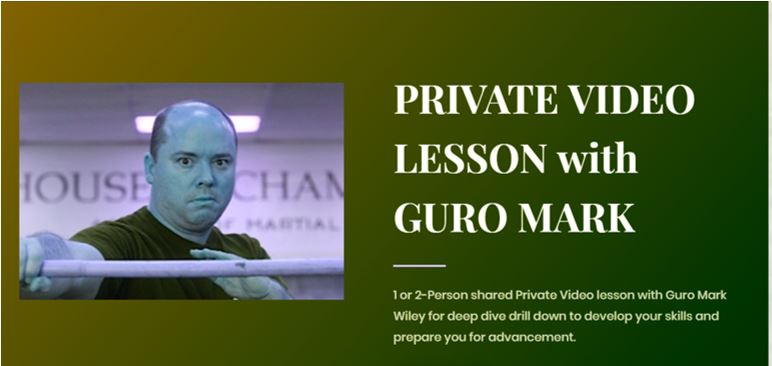
The process of developing skills from a beginner to a master is not easy. Often times, the art is taught in a simple way: learn 12 angles of attack and then defenses and disarms against each of the angles, then add in some reflex and flow drills. There is often a lack of focus on the principles, concepts and strategies in the teaching format. These are the most important aspects of Integrated Eskrima and are brought forth in every lesson. Each lesson is taught with a focus on teaching the student to be able to identify the technique structures: Mode, Range, Gate, Footwork, Defense.
Integrated Eskrima offers a comprehensive training curriculum taught within 12 Modules. Each Module focuses on one specific area of study, and each concept and technique within the Module is fully integrated before moving on to the next Module. The 12 Modules are developed around techniques categorized by the following weapons:
- Solo Baston – Single Stick
- Doble Baston – Double Sticks
- Dos Manos Solo Baston- Two-Handed Single Weapons
- Baston y Daga – Stick and Dagger
- Espada – Sword
- Espada y Daga – Sword and Dagger
- Daga – Knife
- Talahib – Empty Hands
The weapons are taught according to the following classification by method of use:
- Single Weapon, Single Hand
- Single Weapon, Double Hands
- Double Weapons, Equal Lengths
- Double Weapons, Unequal Lengths
- Empty Hands vs. Weapons
Application of Integrated Eskrima is dependent on the proper Linking and Integration of its six Integral Methods. These encompass the nuts and bolts of the system in terms of its composition of movement theories and methods. These are:
- 13 Footwork Methods
- 13 Striking Methods
- 12 Angles of Attack
- 3 Ranges and 4 Modes of Engagement
- 27 Primary Defensive Techniques
- Supporting & Secondary Techniques
- Counters and Reversals
- Feinting Maneuvers
Mastery of the art is gained through the Integrated Modular Training Method (IMTM). In a nutshell the material learned in one module (footwork, strikes, counters, locks) are learned as “individual skills development” and then “integrated” with all other skills in the module, and made “live” through the “nucleus drill.” Once the module is passed, the student learns Module 2. The process repeats. After Module 2 is passed, the material is all then “integrated” with those of Module 1, completely, and made come alive via the “nucleus drill.” There is no moving on to Module 3 until full “integration” of Module 1 and Module 2. Through IMTM, students don’t just memorize specific counter sequences, but they have to modulate and integrate the material into a whole method of application and understanding.
 Integrated Eskrima
Greetings Dr. Mark,
I am a student of the arts and been training for about 25 plus years, last 8 years in JKD, FMA and Silat in particular.
I am a student of/ instructor under GURU Dan Inosanto and represent him from india.
I have high regards for your work and recently came across your system.. quite interested must say.
My question: can I choose modules of my interest ( I am interested in Espada,Dos Manos and Doble baston) along with related material( necessary attributes and drills) with respect to distance learning or do I have to do the whole module by module progression.
Looking forward to interact with you more on this.
Respectfully
– Satyaki
Greetings Satyaki,
Thank you for your correspondence. They way the teaching method of Integrated Eskrima works, is that it is build upon Modules of material. Each Module is composed of material specific to a Mode of applying the art. In this way, Module 1 and 2, completes Mode 1 methods. Module 3 completes Mode 2 etc… so techniques related to Dos Manos or Espada y Daya, for example, are composed of 4 Modes and 5 Modules of the art. Without having that root, then it is just loose techniques, and that goes against the uniqueness of this system. So we do not jump modules, as they are needed to progress through the 4 Modes… which are needed to then apply that to doble baston, espada y daga, dos manos, etc. Hope that makes sense. –Dr. Mark
Hi Mr. Wiley, been a fan since late 90’s with your publications. In the past I tried locating you for Illustrisimo instruction thru Tuttle Publications. I sent an email regarding long distance training. Please let me know when there is a spot available , Sincerely Dean Franco
Hello Dean, Thanks for reaching out. We will having open enrollment in the DLP again in January. Will send you a message as we near the end of this year.